Resources
Resource library
Reference architecture and working definitions for the AI control plane.
Featured
What is the AI control plane?
An emerging term for the governance layer being built by enterprises. The AI control plane unifies connection, identity, policy, and observability across every AI agent in the enterprise.
Read the reference architecture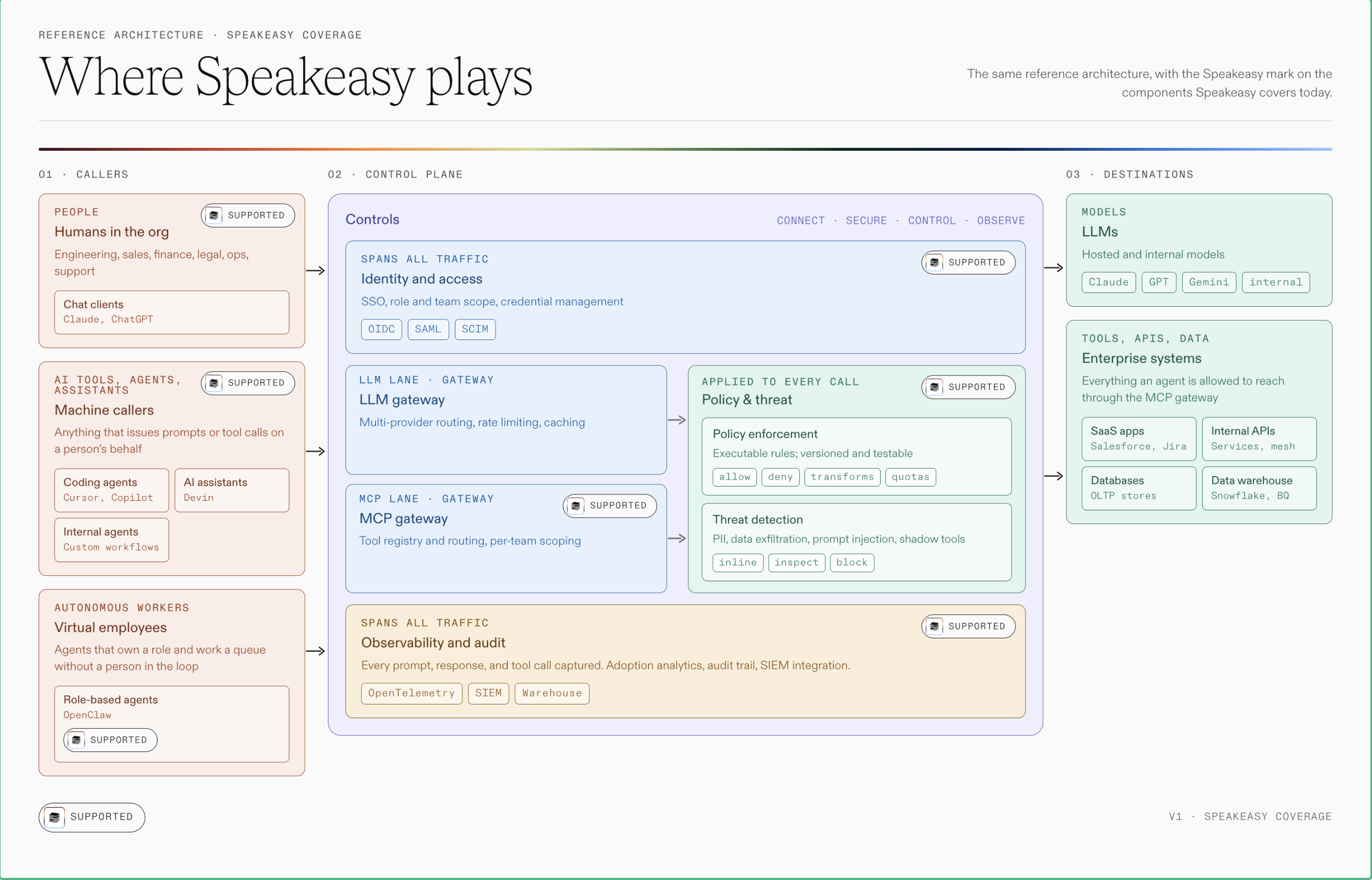
Featured
What is the AI control plane?
An emerging term for the governance layer being built by enterprises. The AI control plane unifies connection, identity, policy, and observability across every AI agent in the enterprise.
Read the reference architectureThe components
The architecture, piece by piece.
Working definitions for the gateways and lifecycle interfaces that make up a production AI control plane.
More from the library
Working definitions for AI leaders.
AI Control Plane and agents
The control layer for AI agents, and the kinds of agents it has to govern.

Reference
AI control plane: the architecture for AI governance and security
The AI control plane is the architecture for AI governance and security, unifying connection, identity, guardrails, and observability across every AI agent.
Published Apr 23, 2026
Reference
Agent control plane: what it is and how it governs AI agents
An agent control plane is the layer that governs a fleet of AI agents from one place. This guide defines the term, explains where it comes from, and shows how it relates to the AI control plane, MCP, and AI gateways.
Published Jul 8, 2026
Comparison
Types of AI agents: autonomous AI agents vs delegated agents
Autonomous AI agents act under their own identity. Delegated agents act on behalf of a person.
Published Sep 2, 2026
Definition
What are user-steered agents?
A user-steered agent is an attended individual agent that runs as a session attached to a person.
Published Sep 2, 2026
Definition
What are background agents?
A background agent executes outside the foreground interaction. Background work is often unattended, but can also stream updates during an attended session.
Published Sep 1, 2026
Definition
What is an agent plugin?
An agent plugin is an installable package that extends an AI agent by bundling reusable capabilities: skills, one or more Model Context Protocol (MCP) servers or connectors, and harness-specific extras such as hooks, rules, commands, or subagents.
Published Sep 11, 2026
Definition
What is an AI security server?
An AI security server is the HTTPS service a model provider calls, with the transcript of a governed request, before inference runs, so the organization can allow or deny that request under its own policy.
Published Sep 16, 2026
Reference
What is AI cost tracking?
AI spend arrives through provider APIs, enterprise seats, and personal subscriptions, and an org-wide key hides who drove it. How to bring every dollar into one ledger, attribute it, and control it before the invoice arrives.
Published Jun 26, 2026
MCP gateways and registries
Routing, approving, and inventorying Model Context Protocol (MCP) servers.
Definition
What is a private MCP gateway?
A private MCP gateway is an MCP gateway reachable only on a private network. How it differs from self-hosted, on-prem, and MCP tunnels, and how to deploy one.
Published Sep 23, 2026
Comparison
Managed vs self-hosted MCP gateway: how to choose
Managed vs self-hosted MCP gateway: compare operations, upgrades, data path, network reachability, identity, and compliance to decide who should run yours.
Published Oct 21, 2026
Definition
What is MCP gateway bypass?
MCP gateway bypass is any route an agent takes to an MCP server around the gateway. The four bypass paths, the layer that closes each, and the limits.
Published Oct 21, 2026
Definition
What is an MCP tunnel?
An MCP tunnel is an outbound-only connection that lets an AI agent or platform outside a private network reach a specific Model Context Protocol (MCP) server inside it, without opening an inbound port or giving the server a public address.
Published Sep 9, 2026
Definition
What is an MCP registry?
An MCP registry catalogs Model Context Protocol (MCP) server metadata, including the server name, install location, and connection method.
Published Aug 25, 2026
Definition
What is an MCP inventory?
An MCP inventory is a continuously updated record of every Model Context Protocol server in an organization: the tools each server exposes, the credentials it authenticates with, who owns it, which agents may call it, and whether it is sanctioned.
Published Aug 20, 2026
Definition
What is MCP governance?
MCP governance manages the MCP servers AI agents connect to through a lifecycle: discover, approve, promote, distribute by role, monitor, and retire.
Published Sep 24, 2026
Identity and access
Binding every agent session to a real principal and scoping what it can reach.
Definition
What is agent identity?
Agent identity is the binding of every AI agent session to a real principal in the organization's directory, the person driving it, or a dedicated identity with a named human owner.
Published Aug 21, 2026
Definition
What is a non-human identity (NHI)?
A non-human identity (NHI) lets software authenticate and access resources. Learn how agents differ from service accounts and the risks of shared API keys.
Published Aug 19, 2026
Definition
What is composite identity for agents?
A composite identity for agents is the tuple bound at the start of a session, the person from the directory, the agent workload, the client, and the task.
Published Aug 21, 2026
Definition
What is agent auth?
Agent auth is how an AI agent proves who it is and is granted access to a resource, on a person's behalf or under a dedicated identity.
Published Aug 25, 2026
Definition
What is agent access management?
Agent access management is the set of controls that decide and enforce what each AI agent may call: which tools, on which systems, under which directory principal.
Published Sep 8, 2026
Guide
How do you extend IAM to agents?
Extending IAM to agents means the same identity provider, groups, and grants that already govern people also govern AI agents, at the tool call, without a second access model.
Published Aug 21, 2026
Definition
What are task-scoped credentials?
Task-scoped credentials are short-lived, identity-bound secrets issued for one agent session, one person, one agent, one task, and revoked when the task ends.
Published Aug 21, 2026
Comparison
Shared credentials vs user-delegated identity for MCP and agents
When a shared service credential is fine for an MCP server or agent, when delegated access is required, and how OAuth, token exchange, and XAA compare.
Published Oct 21, 2026
Definition
What is enterprise MCP authentication?
Enterprise MCP authentication is how an organization's Model Context Protocol (MCP) servers establish who is on the other end of a connection: which client software is asking, and which principal (a person or an autonomous agent) it acts for.
Published Sep 17, 2026
Definition
What is MCP SSO?
MCP SSO is single sign-on that covers Model Context Protocol (MCP) servers: employees and agents authenticate through the enterprise identity provider they already use, and access to approved servers is granted from that IdP instead of a consent screen per server.
Published Aug 21, 2026
Comparison
MCP tool allowlists vs per-call authorization
An MCP tool allowlist fixes which tools are exposed. Per-call authorization decides each call by identity, arguments, and policy.
Published Oct 21, 2026
Definition
What is agent session management?
Agent session management is the ability to watch, quarantine, and end a running AI agent session remotely.
Published Sep 23, 2026
Security and threats
The attacks agents face, and how to find AI that no one has approved.
Reference
What is AI security?
AI security spans five layers, network and infrastructure, MCP gateway, agent runtime, data, and governance, each with different threat models and different vendors. A map of the landscape.
Published May 14, 2026
Reference
MCP Security Best Practices
MCP security is the runtime controls that decide which agents may connect to MCP servers, which tools they may call, and how every invocation is attributed and logged.
Published Aug 19, 2026
Security taxonomy
Prompt injection: a real taxonomy
Direct, indirect, stored, and cross-agent. The four shapes prompt injection takes, where each enters an agent, and the control that actually catches it.
Published Jun 12, 2026
Threat reference
Tool poisoning attacks against MCP servers
How a poisoned tool description turns an MCP server into an exfiltration path, why model-layer defenses miss it, and where the MCP gateway stops it.
Published Jun 11, 2026
Reference
What is shadow AI?
Shadow AI is the AI your organization uses that no one with a security mandate has seen. A reference for leaders who need to detect and govern it.
Published May 5, 2026
Definition
What is shadow MCP?
Shadow MCP is an unapproved Model Context Protocol (MCP) server. Learn how it affects MCP security, why asset inventories miss it, and how to discover and govern unsanctioned MCP connections.
Published Aug 24, 2026
Guide
How do you discover agents that aren't in the inventory?
Agent discovery is the continuous process of finding every AI agent in an organization that is not yet in the inventory, and turning each finding into a record with an owner and a disposition.
Published Aug 20, 2026
Definition
What is an agent inventory?
An agent inventory is a continuously updated record of every AI agent in an organization: the identity it runs as, the human who owns it, the tools and data it can reach, and whether it is sanctioned.
Published Aug 20, 2026
Definition
What is agent DLP?
Agent DLP is the set of controls that inspect what an AI agent is about to send, to a model, to a tool, or to an MCP server, and block or redact payloads that contain data the organization is not allowed to share.
Published Aug 20, 2026
Definition
What are agent guardrails? Layers, levels, and vendors
Learn how AI agent guardrails control approved agents, access, and data exfiltration across four layers, with vendors and rollout trade-offs.
Published Oct 7, 2026
Definition
What is vibe coding security?
Vibe coding security is the set of controls that keep employee-built apps from Lovable, Base44, v0, and similar builders from reaching production data and Model Context Protocol (MCP) servers the security team never approved.
Published Sep 1, 2026
Governance and compliance
Turning AI policy into enforced controls, and mapping them to the frameworks auditors use.
Definition
What is AI governance?
AI governance in 2026 isn't about training fair models. It's about controlling what AI tools are allowed to see, do, and decide on your behalf.
Published May 11, 2026
Definition
What is an AI governance platform?
The software that turns AI governance from written policy into a control enforced on every prompt and tool call. The category, the two kinds of platform, and how it differs from AI security.
Published Jun 4, 2026
Definition
What is AI agent governance?
AI agent governance is the set of controls an organization runs over what its AI agents may see, do, and decide, from identity and tool access to audit.
Published Sep 8, 2026
Definition
What is skills governance?
Skills governance is the set of controls that keep a live record of every agent skill in an organization: which file it is, who owns it, which agents load it, whether it is sanctioned, and what tools it tells those agents to call.
Published Aug 20, 2026
Reference
Agent compliance
Claude and ChatGPT expose compliance APIs that export the chat record; Cursor and Copilot do not, and GRC platforms only detect violations after the fact. Where ISO 42001, AARM, and Agentic Trust Controls sit in the stack, and why enforcement in the request path closes the gap.
Published Jun 23, 2026
Controls reference
ISO 27001 for agentic AI
ISO 27001:2022 already contains the controls that govern AI agents. What moved is where they have to be enforced, which is at the tool call. Fourteen Annex A controls, re-answered for agents.
Published Aug 17, 2026
Definition
What is ISO 42001 for agentic AI?
ISO/IEC 42001:2023 is the international AI management system standard. How it applies to agentic AI, how it relates to ISO 27001, and what runtime evidence can support an audit.
Published Aug 19, 2026
Frameworks comparison
AI security frameworks compared
NIST AI RMF, MITRE ATLAS, and OWASP: what each framework covers, where each stops, and where enforcement infrastructure closes the gap.
Published May 21, 2026
Definition
What is MITRE ATLAS?
MITRE ATLAS is a public knowledge base of adversary tactics and techniques against AI systems.
Published Oct 23, 2026
Definition
What is AARM?
AARM (Autonomous Action Runtime Management) is the Cloud Security Alliance system-category specification for agentic runtime security: it defines what an agent security system must do to govern what an AI agent is allowed to do at runtime, before the action executes.
Published Aug 21, 2026